As any for-profit business, online business is no different in terms of a its need for a revenue model. Revenue model can be perceived as an integral part of a business model, as it sets the expectations of how the business will make money: there are numerous ways in which it can be done, and most businesses are not limited to use of only one model, however, the right revenue model will help in reaching goals and sustaining long-term growth of your venture.
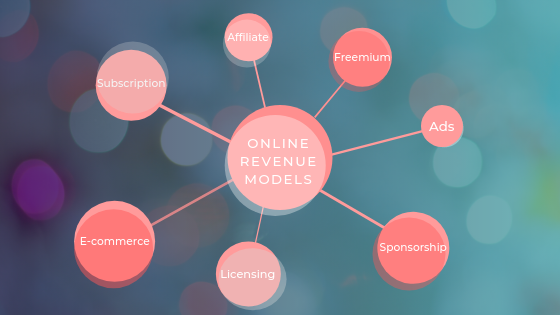
In this article, let’s take a look most popular online revenue models, so keep reading to learn more.
1. Advertising
In this model, fees are generated from advertisers, in exchange for advertisements placed in the media space belonging to a business. For example, if you own a website, you can rent out its digital real estate and generate revenues passively, with very little investment – an attractive deal, isn’t it? However, beware that too many ads can negatively impact your website’s SEO rankings – nobody likes too many ads.
Examples include:
- Display Ads – e.g. Facebook
- Search Ads – e.g. Google
- Video Ads – e.g. YouTube
- Audio Ads – e.g. Spotify
- Paid content promotion
2. Freemium model
The freemium business model offers basic services for free for the user to try and more advanced or additional features at a premium. Freemium model is beneficial if you aim to increase your product’s user-base and generate more revenue with micropayments.
And here are some examples:
- Adobe Flash
- Evernote
- Prezi
- Skype
- WordPress
- Mobile games like Farmville, Angry Birds etc.
3. E-commerce
To put it simply, e-commerce is when commerce meets internet. As in the traditional, offline commerce, it is just as important to plan a revenue model. The simplest and most commonly used – direct sales model – involves setting up an online store and shipping the goods when the money is paid by the customer. E-commerce allows to sell internationally 24/7 at a lower financial cost, utilize multiple modes of payment, and provides you with the crucial in-depth analysis of transactions.
See these examples:
- Retailing – e.g. Ikea
- Marketplace – e.g. Amazon
- Sharing Economy – AirBnB
- Aggregators – e.g. Uber
- Group buying – e.g. Groupon
- Digital goods / downloads – e.g. iTunes
- Auction commerce – e.g. eBay
4. Affiliate Marketing
The affiliate is the entity, which generates revenue usually in commission form from selling products or services owned other another entity or generating leads so that the main owner can convert the leads into possible sales.
5. Subscription Model
In a subscription revenue model, users are charged a periodic fee which allows them to gain access to content – we are all familiar with how newspaper subscriptions or gym memberships work. Similarly in the digital world, users can subscribe or gain membership to use services. The subscription model is not suitable for all businesses, however, those whose business is suitable for a subscription business model, enjoy higher consumer retention, better cash flow management, and make use of the many opportunities to engage with consumers regularly.
Examples:
- Software as a Service (SaaS) – e.g. Dropbox, Slack
- Membership Services – e.g. Amazon Prime
- Paywall – e.g. The Economist, NYtimes
6. Licensing
A common revenue model among software companies, this model is however losing its appeal due to the emerging trend of subscription models. The revenue is earned by allowing other parties to use protected intellectual property for fees.
A few examples:
- Per Device/Server License – e.g. Microsoft products
- Per Application instance – e.g. Adobe Photoshop
- Per Site License – e.g. Private cloud on internal infrastructure
7. Sponsorship/Donations
The sponsorship or donation revenue model allows users to willingly donate money to support an initiative.
Examples:
- Khan Academy
- The Guardian
- Many browser extensions and WordPress plugins etc.
This sums up the shortlist of the most commonly used online revenue models. In an increasingly complex digital world, choosing the right revenue model will make or break your business, so – choose wisely, taking into account unique characteristics of your business, and remember that the key is to find the model that serves both your goals and your customers’ needs.
Good luck!
Useful articles:
- https://www.eukhost.com/blog/webhosting/what-is-a-revenue-model/
- https://www.feedough.com/ecommerce-101-ecommerce-business-revenue-models/
- https://www.webfx.com/internet-marketing/online-revenue-models-to-consider.html
- https://stopad.io/blog/subscription-revenue-model-challenges
- https://www.marsdd.com/mars-library/licensing-as-a-revenue-model-for-technology-products/
- https://yourstory.com/2014/03/ultimate-master-list-revenue-models-web-mobile-companies

 METU Digital Marketing